







Labeling machines demand rapid start-stop cycles, sub-millimeter placement accuracy, and zero tolerance for downtime. When selecting motion control components for packaging machinery, engineers typically face one core decision: AC servo motor or closed loop stepper motor?
This article breaks down the technical trade-offs across three dimensions: standstill stability, torque-speed characteristics, and dynamic response. The goal is to help you match the right motor type to your specific labeling and packaging application. For a broader view of Leadshine's industry-specific deployments, see our motion control solutions.
Why Do Servo Motors Vibrate at Standstill While Steppers Hold Firm?
A closed loop stepper motor holds position with zero oscillation. A servo motor does not.
The difference comes down to control architecture. An AC servo motor relies on a PID (Proportional-Integral-Derivative) control loop that continuously corrects any position error detected by the encoder. At zero speed, even a position error smaller than one encoder count causes the integral term to accumulate over time, eventually producing a corrective output.
The motor nudges forward, overshoots by a fraction, and then corrects again in the opposite direction. This repetitive micro-correction is known as "dithering." As the Motion Control & Motor Association explains, when a servo motor sits at zero position with active oscillation, it is continuously drawing current and fighting itself, which can generate heat over time.¹
A stepper motor uses a fundamentally different holding mechanism. When energized, the permanent magnet rotor locks to the nearest magnetic equilibrium point created by the stator's electromagnetic field. This electromagnetic locking force is known as holding torque, the maximum torque that can be applied to the energized rotor before it is forced to rotate one full step.²
No PID loop hunts for an error signal. The rotor is held in place by magnetic attraction, producing no audible noise and no mechanical vibration at standstill.
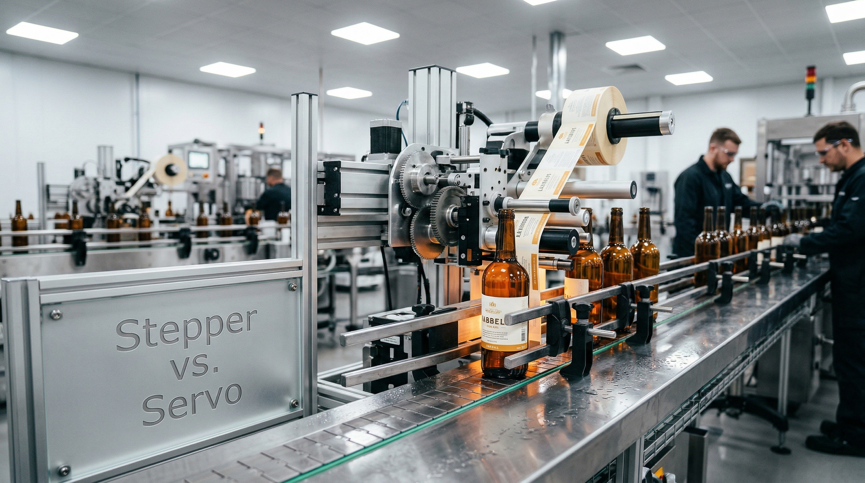
For labeling applications, this distinction matters directly. During label application, the feed axis must pause at an exact position while the label transfers onto the product. Any micro-oscillation at this point causes label misalignment, wrinkles, or skewed print registration. A closed loop stepper motor eliminates this risk by design.
At What Speeds Does Each Motor Type Deliver the Most Torque?
Stepper motors produce their highest torque density between 0 and 1,500 RPM. Servo motors overtake only above 2,000 RPM.
This characteristic is determined by the physical construction of each motor type. A hybrid stepper motor (also referred to as a hybrid servo motor in some industry contexts) generates peak torque at low speeds because the electromagnetic interaction between rotor teeth and stator poles is strongest at rest and degrades gradually as speed increases.
A typical NEMA 23 closed loop stepper motor can deliver 2.0–3.0 N·m of holding torque, with usable dynamic torque remaining above 50% of rated value at 1,000 RPM.
AC servo motors are designed for continuous rotation. Their torque output remains relatively flat up to rated speed (typically 2,000–3,000 RPM), then drops off. This makes them well suited for applications requiring sustained high-speed operation.
The key question is: what speed range does your labeling machine actually operate in? In a typical labeling system, the label feed axis and the conveyor axis are electronically geared together, with cycle times of 20–100 ms per label.³
After accounting for gear reduction (common ratios of 5:1 to 20:1), the motor shaft speed for most labeling and packaging systems falls within 200–1,200 RPM. That sits squarely inside the range where stepper motors deliver their maximum torque output. Specifying a servo drive for an application that never exceeds 1,200 RPM means paying for high-speed capability that remains unused.
Which Motor Settles Into Position Sooner After Each Move?
Closed loop stepper motors reach their target position and stabilize within 1–2 milliseconds of the final step. Servo motors typically require 5–15 ms of PID settling time after deceleration.
When a servo motor completes a move, its PID controller must work through a damping sequence. The position overshoots slightly, reverses, and oscillates with decreasing amplitude until the error falls within the "in-position" window. In PID tuning literature, achieving a critically damped response with a 10 ms settling time on a servo axis is considered a well-tuned result.⁴
A stepper motor does not overshoot in the same way. Each step command moves the rotor to a discrete magnetic equilibrium point. When the last step pulse is sent, the rotor locks to that position. With closed loop feedback, any transient position deviation is detected and corrected within 1–2 step intervals, without the oscillatory behavior inherent in continuous PID control.
In packaging machinery with short-stroke indexing, such as label dispensing where the feed axis moves 30–100 mm per cycle, these millisecond differences compound across hundreds of cycles per minute. Reducing settling time by even 5 ms per cycle at 200 cycles/minute recovers 1 full second of productive time per minute, directly improving throughput.
How Does Closed Loop Feedback Prevent Step Loss and Support Safety Compliance?
Encoder feedback transforms traditional stepper reliability into verified, traceable positioning.
The historical weakness of open-loop stepper motors was "loss of step." If external torque exceeds the motor's available torque at a given speed, the rotor slips out of synchronization with the commanded position. Every subsequent move then accumulates additional error, and the operator receives no warning because there is no feedback to detect the failure.
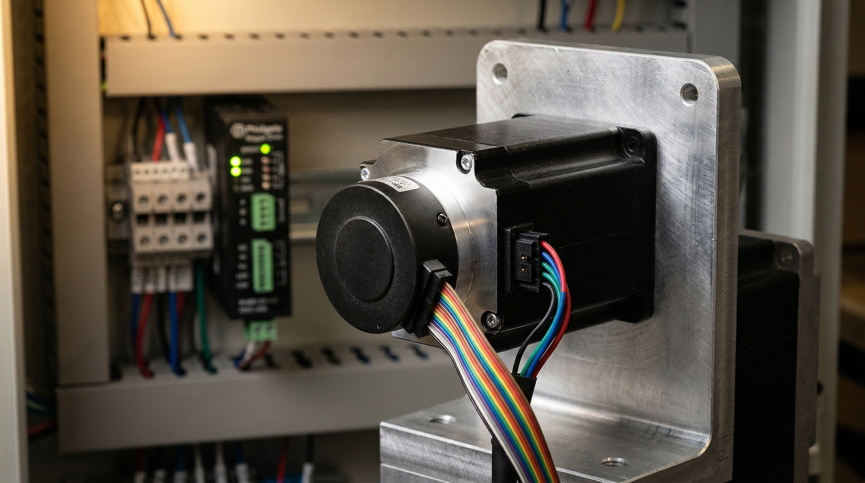
A closed loop stepper motor eliminates this risk by integrating an incremental encoder (typically 1,000-line or 5,000-line resolution) that continuously verifies rotor position against the commanded trajectory. If a position deviation exceeds the configured threshold, the drive increases current to correct it. If correction fails, the drive triggers an alarm output and halts the axis, preventing the machine from continuing to apply labels at incorrect positions.
This alarm-and-halt capability also aligns with industrial safety frameworks. The EU Machinery Regulation (EU) 2023/1230, which replaces Directive 2006/42/EC starting January 2027, includes updated requirements under Clause 1.2.1. It specifies that control systems must be designed to prevent hazardous situations and withstand intended operating stresses.⁵ A closed loop stepper drive with configurable alarm outputs provides a documented, traceable safety response to position faults. Open-loop stepper systems cannot fulfill this requirement.

Selection Summary: When to Choose Servo vs. Closed Loop Stepper
The closed loop stepper motor vs servo decision depends on application-specific operating conditions, not on which technology is "newer" or "more capable" in abstract terms. Framing the step motor vs servo motor comparison as "which is superior" misses the point. Each excels in a different part of the performance envelope.
Choose an AC servo motor when the application requires continuous rotation above 2,000 RPM, operates with highly variable loads that change dynamically during motion, or demands multi-turn absolute positioning over long travel distances.
Choose a closed loop stepper motor when the application involves short-stroke indexing (under 200 mm per move), requires zero-vibration standstill during positioning, operates at or below 1,500 RPM, and prioritizes torque density and system cost over maximum speed.
For labeling and packaging machines, the operating profile aligns directly with the strengths of closed loop stepper technology: rapid start-stop at moderate speed, precise positioning during label application, and repeatable short-stroke indexing.
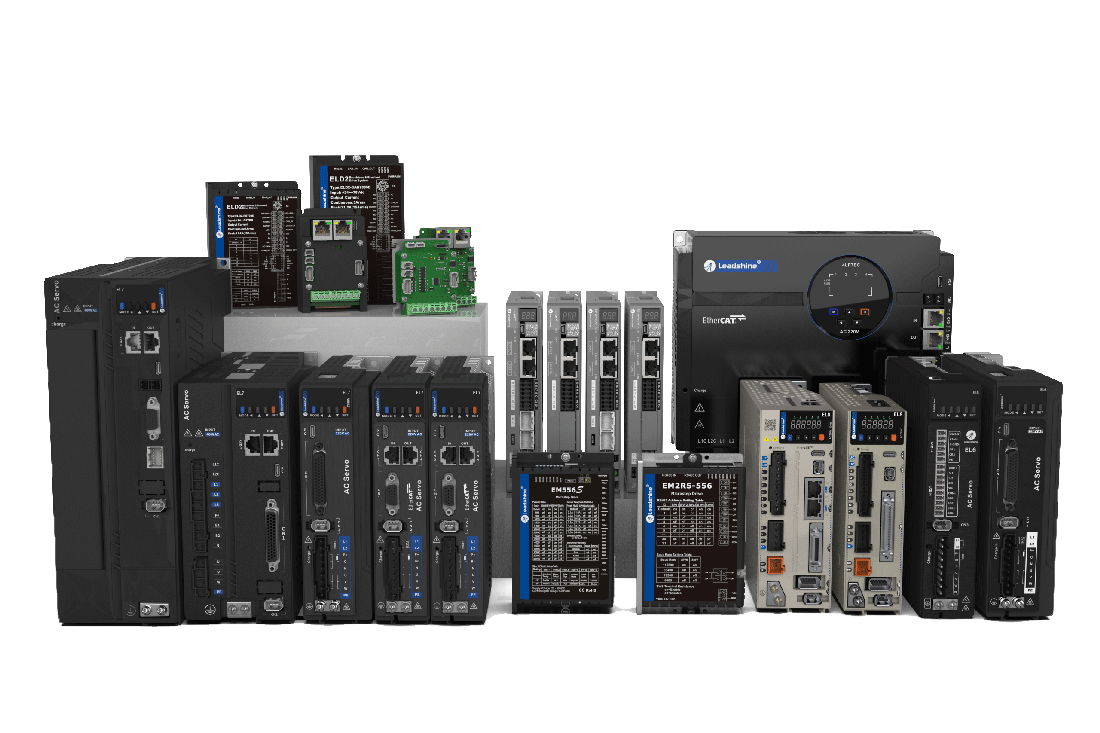
Leadshine's CS Series and CS3E Series closed loop stepper drives, paired with CS-M Series closed loop stepper motors, are engineered for this exact application profile. The CS3E Series supports EtherCAT communication with CiA 402 operating modes (Profile Position, Profile Velocity, Cyclic Synchronous Position, and Homing), covers NEMA 8 through NEMA 34 frame sizes, and includes built-in protections for over-voltage, over-current, position following error, and encoder cable fault.
These drives integrate with mainstream EtherCAT controllers from Beckhoff, Omron, Trio, and Keyence, enabling direct deployment into existing packaging line architectures without custom integration work.
References
1. "Industry Insights: Tuning Up." Motion Control & Motor Association (Automate.org), www.automate.org/industry-insights/tuning-up.
2. "FAQ: What's the Difference Between Detent Torque and Holding Torque?" Motion Control Tips, 17 Oct. 2022, www.motioncontroltips.com/faq-whats-the-difference-between-detent-torque-and-holding-torque/.
3. "Labeling Machine Motion Control System." Oracle Robotics, oraclerobotics.com/application-examples/labeling-machine-motion-control-system/.
4. "Servo Tuning Deep Dive: Black Art, Rocket Science, or Walk in the Park." PMD Corp, www.pmdcorp.com/resources/type/articles/get/servo-tuning-deep-dive-black-art-rocket-science-or-walk-in-the-park-article.
5. "Regulation (EU) 2023/1230 of the European Parliament and of the Council of 14 June 2023 on Machinery." EUR-Lex, eur-lex.europa.eu/eli/reg/2023/1230/oj/eng.